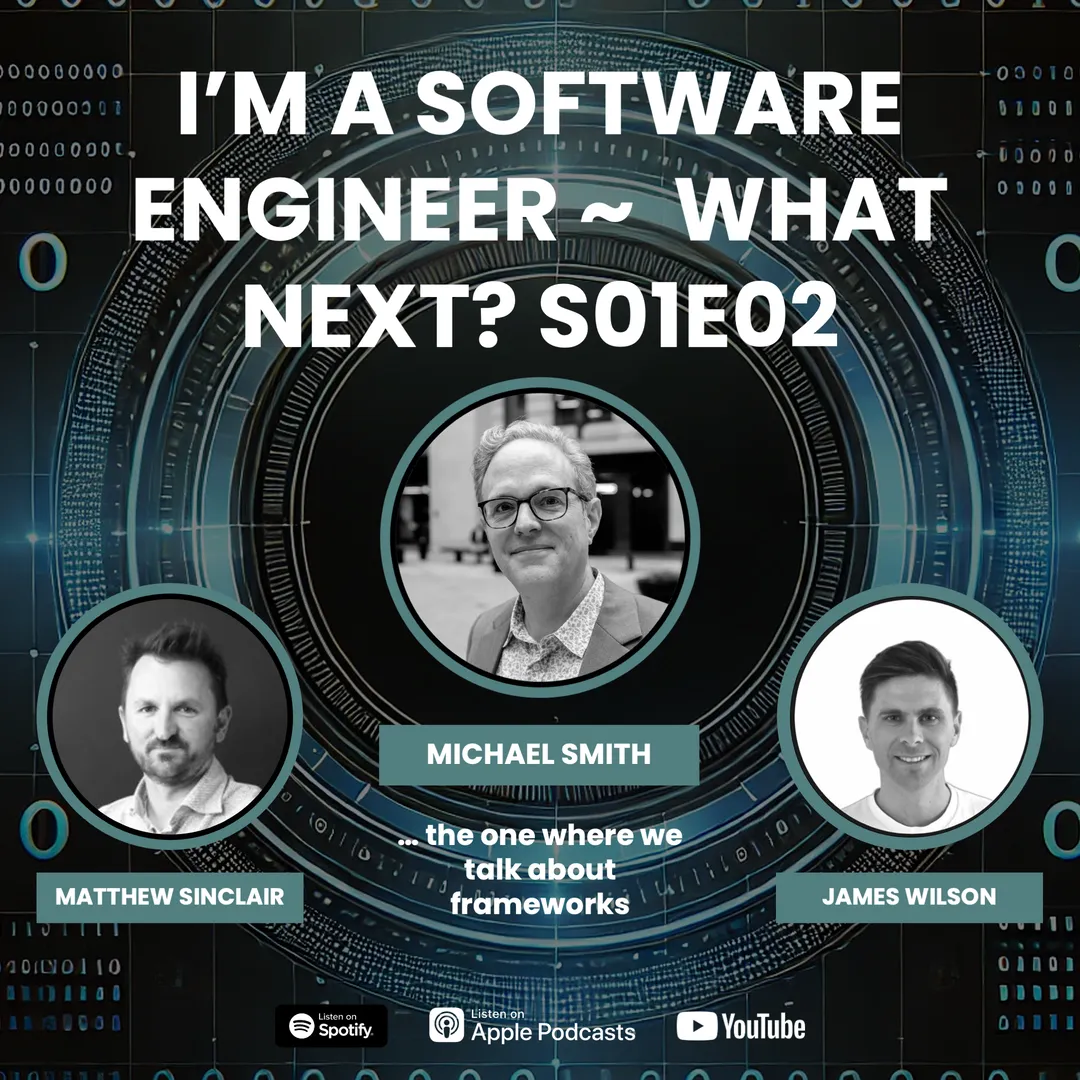
Welcome back to I'm a Software Engineer ~ What Next? The podcast for devs figuring out their next move. Hosted by James Wilson and Matt Sinclair, we talk honestly about what it takes to build a meaningful career in tech.
This week we're joined by Michael Smith, CEO of Sagittal.AI. Michael started out as a software engineer at Qualcomm during its hypergrowth, writing test tools for its 3G cellular base station, and has moved between engineering and product ever since: Globalstar, an MBA, product at Amazon and Yahoo, head of software on some of the first Android handsets in London, ads product at Google, SwiftKey, and product leadership at a run of startups before founding his own.
In this episode, we cover:
- What Qualcomm got right in hypergrowth: engineers will forgive a missing desk, but not being kept from building
- Always being the engineer asking "why are we building this?", and how that led from staff engineer to an MBA and into product
- Whether an MBA still makes sense today, and the mistake of leaving your engineering self behind
- Why the best product managers are technical, and what the rise of the CTPO means for the CPO role
- The creative engineer: bringing an engineering sense of what's possible to product problems
- What universities should teach instead: design patterns, systems thinking and how engineers approach problems
- Matt on learning how to learn, and a personal software process built on foundations, tools, and playing well in the sandpit
- The Cynefin framework: simple, complicated, complex and chaotic problems, and why mistaking one for another is the essence of bad management
- Where AI fits: hand it the simple and complicated work, keep humans on the complex, and conjecture as the human part
- Sagittal's AI, Neo, taking work from ticket to pull request inside the tools teams already use
- What he'd tell his younger self: know who you are, chase what interests you, and be brave enough to be uncomfortable
⏱️ Chapters
- 0:00 Intro: why we build things, and whether AI is coming for your job
- 0:50 Meet Michael Smith: Qualcomm test tools, Globalstar, an MBA and product
- 2:29 What Qualcomm got right in hypergrowth: engineers forgive a missing desk
- 3:41 Staff engineer to MBA: don't leave your engineering self behind
- 5:53 Does an MBA still make sense today, and why not just go into management?
- 8:36 After the MBA: Amazon, Yahoo, Android handsets in London and Google ads
- 11:39 Why the best product managers are technical, and the rise of the CTPO
- 14:02 The creative engineer: an engineering sense of what's possible
- 16:46 What universities should teach instead: design patterns, systems thinking
- 18:38 Matt on learning how to learn: foundations, tools and the sandpit
- 21:53 The Cynefin framework: simple, complicated, complex and chaotic problems
- 25:21 Where AI fits: give it the simple and complicated, keep humans on complex
- 27:22 Predictive frameworks, fractal problems and conjecture as the human part
- 29:58 Sagittal's AI, Neo: lifting the complicated work inside your existing tools
- 32:58 Ticket to pull request: Neo's typical use cases, and PRDs into tickets
- 35:33 The magic telephone: know who you are, chase what interests you, be brave
- 37:57 Leaving for the right reasons, knowing yourself, and equanimity
- 40:42 Wrap-up: where to find Sagittal, and why the sagittal plane
🔗 Links
🗒️ Show Notes
- The Cynefin Framework — The Cynefin Co
- The Beginning of Infinity — David Deutsch, on conjecture
🗣️ Guest
- Michael Smith — https://www.linkedin.com/in/myksmith/
🎙 Hosts
🌐 More from us
🎬