Welcome back to I'm a Software Engineer ~ What Next? The podcast for devs figuring out their next move. Hosted by James Wilson and Matt Sinclair, we talk honestly about what it takes to build a meaningful career in tech.
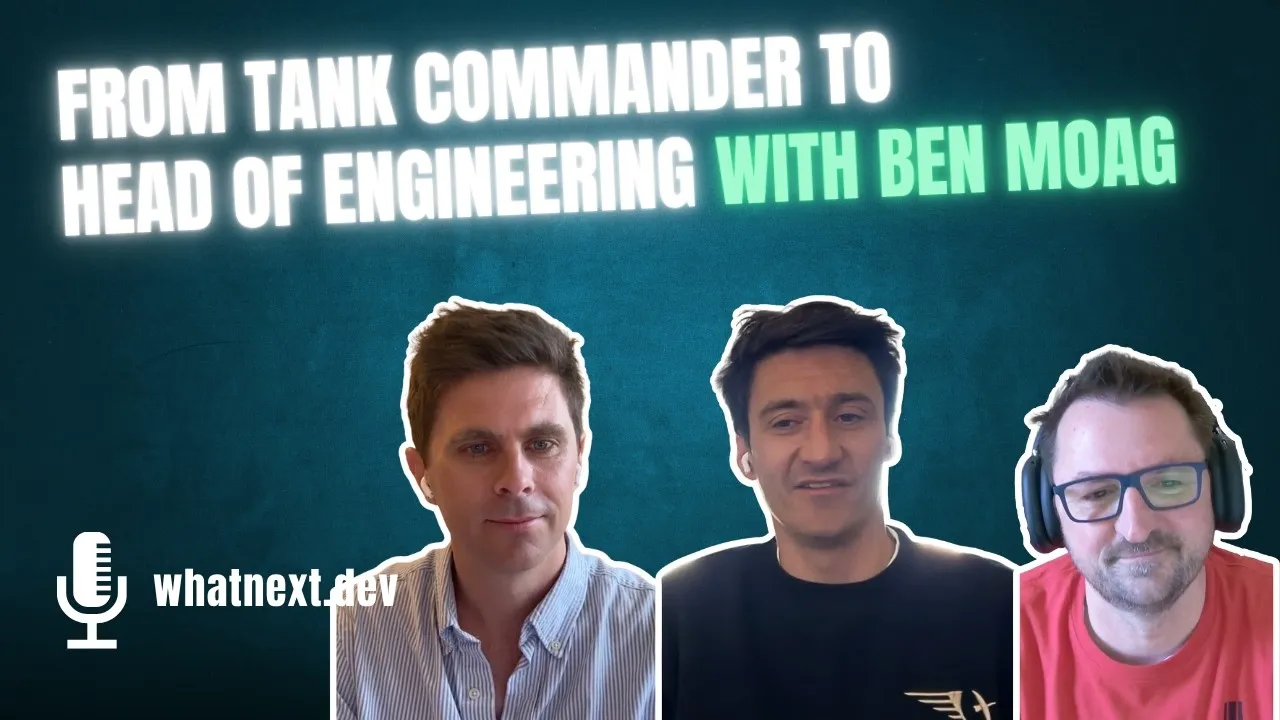
This week we're joined by Ben Moag, Head of Engineering at InsurX. Ben's path is not the usual one: computer science at Bristol, then Sandhurst and a stint as a tank commander in the British cavalry, then a decade in finance — central risk trading at Citi, quant portfolio management at a hedge fund — then the standard quant PM ending of burnout and a divorce, and now his sixth greenfield build, this time rebuilding the InsurX platform live while the business is still running on it.
In this episode, we cover:
- Ben's "if you bend it, you have to mend it" philosophy and why a chaotic childhood is good career preparation
- Why a quant trading floor is more stressful than commanding a tank
- The Citigroup coffee story and what high-trust teams actually look like
- Managers care about outcomes, leaders care about repeatable outcomes
- Why Ben lets his team veto his hires before he ever sees a CV
- The AI quality cliff in March and April, what's causing it, and what to do about it
- "Only ask AI a question you know the answer to" and other rules for surviving agentic coding
- Advice for engineers a year or two into their career, and why this is the most exciting time to be building tech since the 80s
⏱️ Chapters
- 0:00 Intro: Matt's move to Nottingham and an Atari t-shirt
- 0:51 Meet Ben Moag: Bristol, tank commander, Citi trader, hedge fund PM, InsurX
- 3:54 The magic telephone: a little patience, and confidence it will all work out
- 6:27 Tank or trading floor? And a chaotic childhood as career preparation
- 10:44 "If you bend it, you have to mend it": the British cavalry as finishing school
- 13:43 What the army taught him: confidence to lead, and soldiers don't want your job
- 17:39 Is the army the real world? And "why is it you're desperate to kill people?"
- 21:42 Management maintains, leadership deploys: rank vs respect and high-trust teams
- 25:37 The Citigroup coffee story: get the coffee, shut up, become the best trader
- 27:57 Situational leadership: from tell to delegate, and special forces trust
- 30:32 The walk and talk: coffee runs as one-on-ones, and sending two people together
- 33:27 Psychological safety: the junior who called out Ben's standup notes
- 35:48 Why Ben lets the team veto his hires, and "Everyone Lies to Leaders"
- 38:58 The cost of career pivots: a lost RAF place and a borrowed Barclays form
- 41:21 "This has to work out": burnout, divorce, failure is OK, and can you do both?
- 45:15 Hates technology, loves simple solutions: the army qualifications database
- 47:46 Simple is not easy, and why he doesn't need seven figures to be happy
- 50:22 AI as a supercharger: the InsurX rebuild and 8 billion tokens by February
- 53:50 The AI quality cliff in March and April: back to hand-cranking Python
- 55:23 "Only ask AI a question you know the answer to": AI does the how, never the why
- 58:10 A call stack from four layers to 40: what shorter context windows are doing
- 1:00:48 Managers care about outcomes, leaders care about repeatable outcomes
- 1:02:26 Advice for engineers a year or two in: be worried, and focus on outcomes
- 1:04:25 "This is our 80s": lean into it, and the luck behind six greenfield builds
- 1:07:50 Wrap-up: the functional programming sermon saved for a follow-up
🔗 Links
🗒️ Show Notes
- "Everyone Lies to Leaders" — the 2021 article Matt referenced
- "The time cost of 'how' is zero"
- Situational Leadership
- The uncanny valley
🗣️ Guest
- Ben Moag — https://www.linkedin.com/in/benmoag/
🎙 Hosts
🌐 More from us
🎬